SubPro Book a fit call

Most submittal tools build you a list. We build the submittals.

SubPro reads the spec book, finds every submittal your trade owes, and drafts each submittal package with the product data and cover sheet the architect expects. You check it. You send it.

Prefer to start with output? Build my log turns one spec book into a drafted submittal log, no call required.

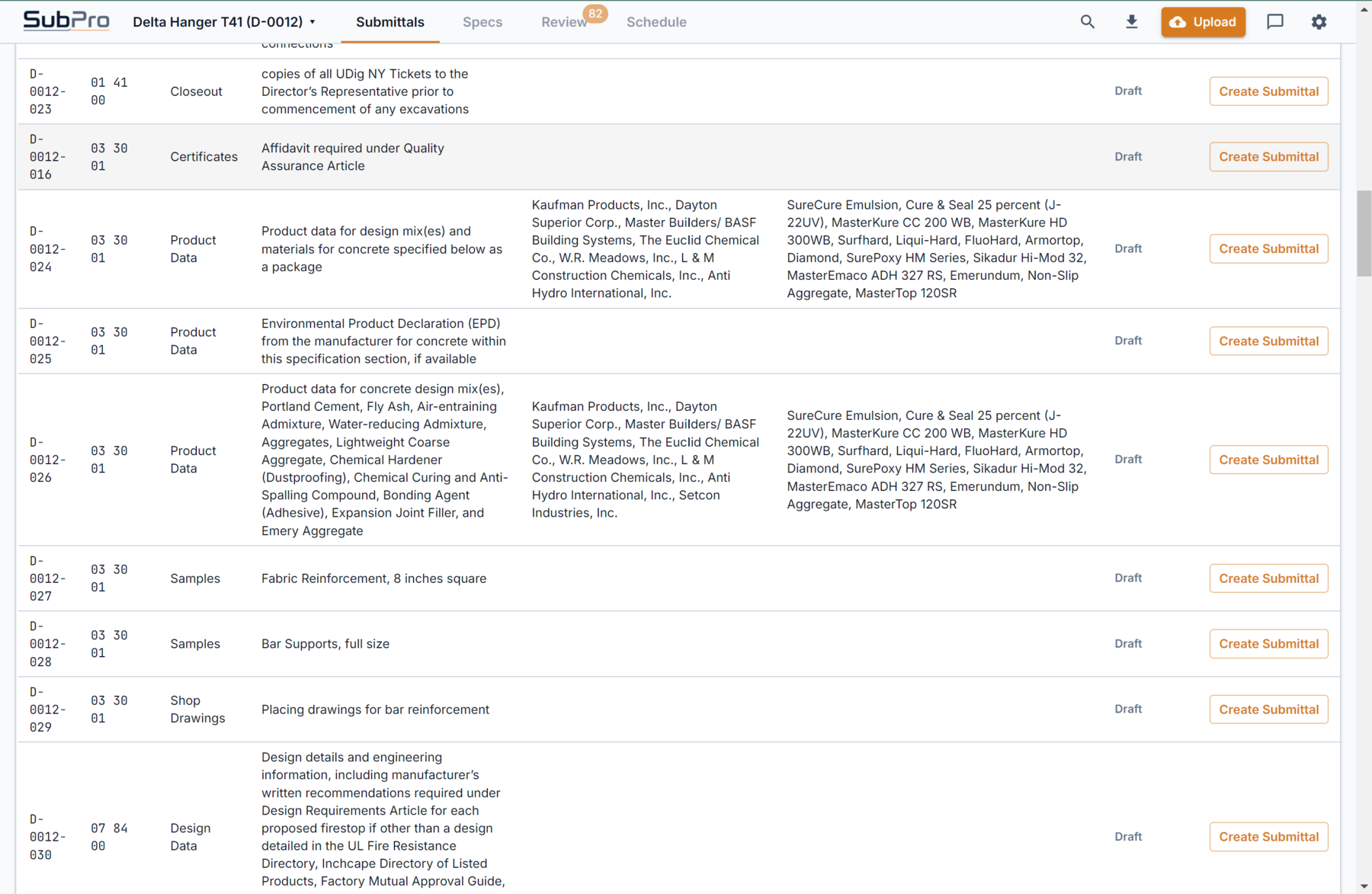
Every row cites its page The spec page number sits beside each requirement, so review starts at the source instead of at a spreadsheet.
A person reviews before delivery Flagged rows get a construction PM's read. Nothing moves forward unread.
Your files leave with the deliverables The spec book is deleted after delivery. It is never kept on file or used for training.

Hundreds of pages in. A submittal schedule that does not wait.

Most of the time between award and first submittal goes to reading, transcribing, and chasing manufacturer documents. None of that needs a project manager. The decisions do: which product, which or equal, which rows the architect will push back on.

SubPro takes the reading and the assembly. Your team keeps the calls. Every row arrives with the spec page that created it, so checking the work takes minutes, not the week it took to build it.

Reads. Finds. Drafts. Flags.

Read the full method
Step 1

Reads the spec book

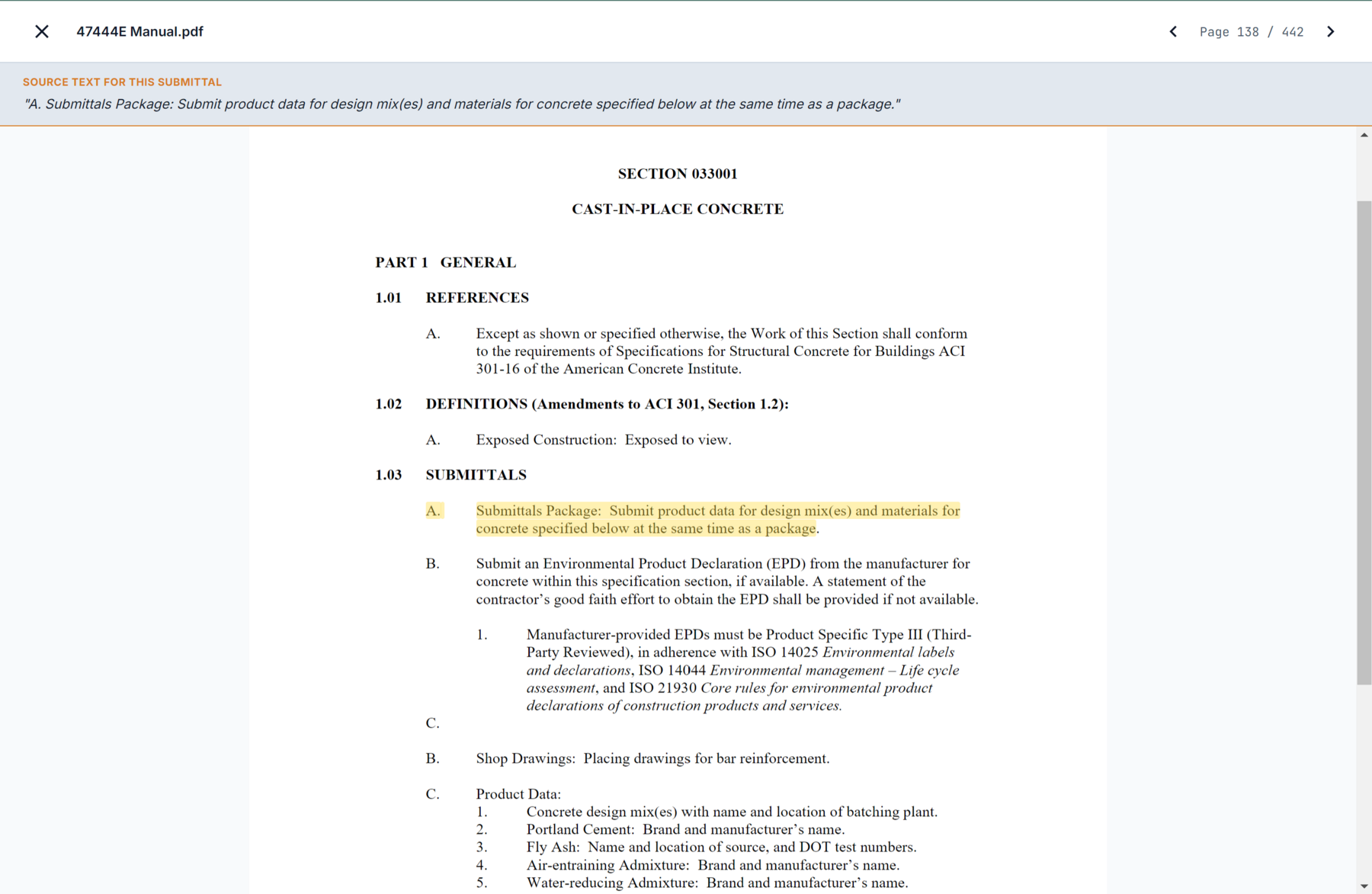
Send the project manual. SubPro reads every section front to back, for this job only, and keeps the page number attached to everything it finds.


47444E Manual.pdfPage 138 of 442
A spec book page open at Section 033001 with the submittal requirement highlighted and quoted as the source text
Step 2

Finds every submittal your trade owes

Each required submittal becomes a row in the log: section, type, description, and the page that asked for it. Divisions group themselves.

Submittal logTower 28 Rev28, 490 rows
The SubPro submittal log grouped by CSI division, with spec section, type, description, and status for each row
Step 3

Drafts the submittal package

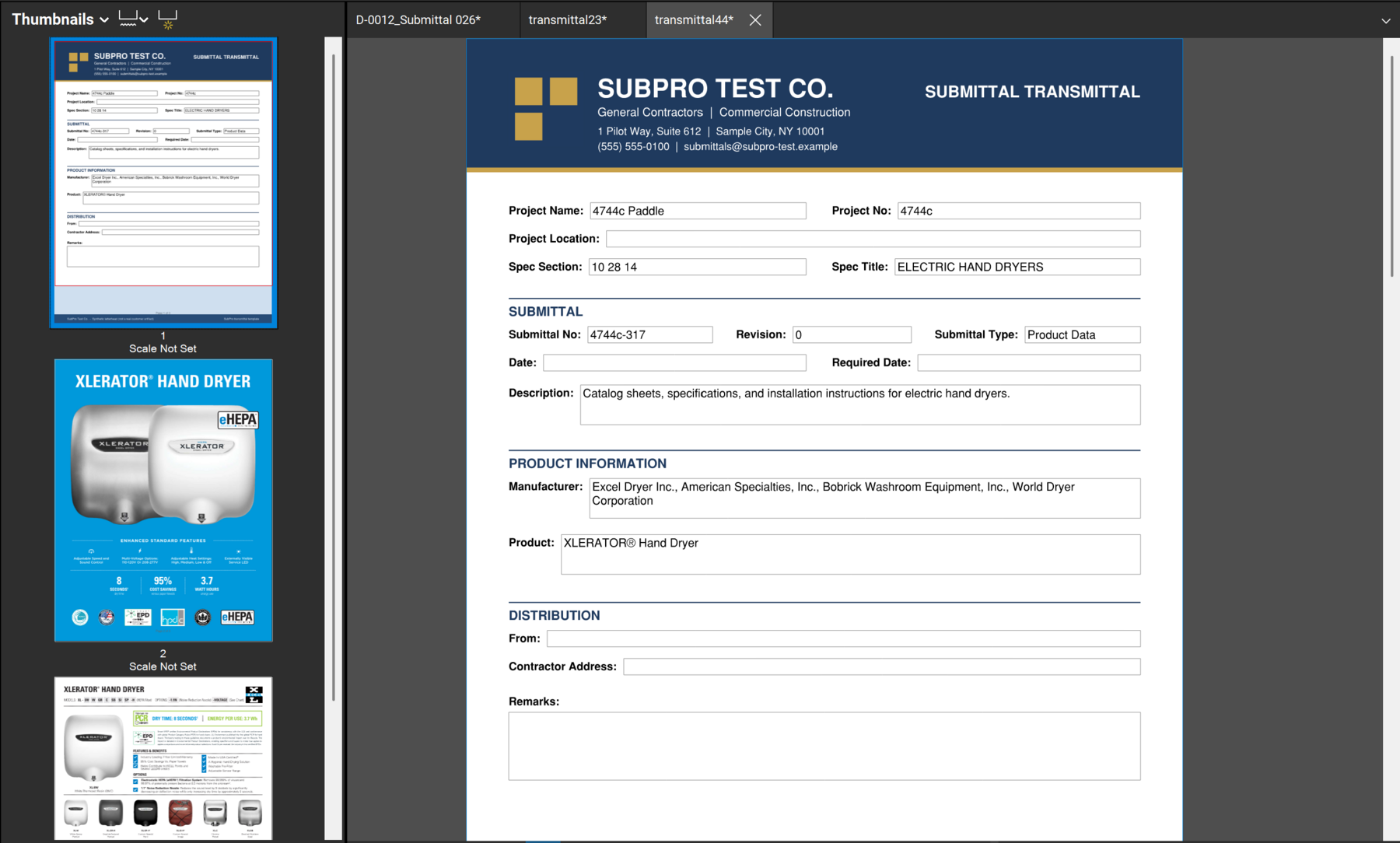
Product data from the manufacturer library stacks behind a completed cover sheet and transmittal. One submittal package per row, ready for your review.

Submittal SC 000004-005Section 09 91 13 Exterior Painting
A completed submittal cover sheet for Section 09 91 13 Exterior Painting, listing the manufacturer and product
Step 4

Flags the rows that need a call

An or equal, an owner selection, a vague note: anything that needs judgment is flagged with the page behind it. Your PM decides. SubPro does not.
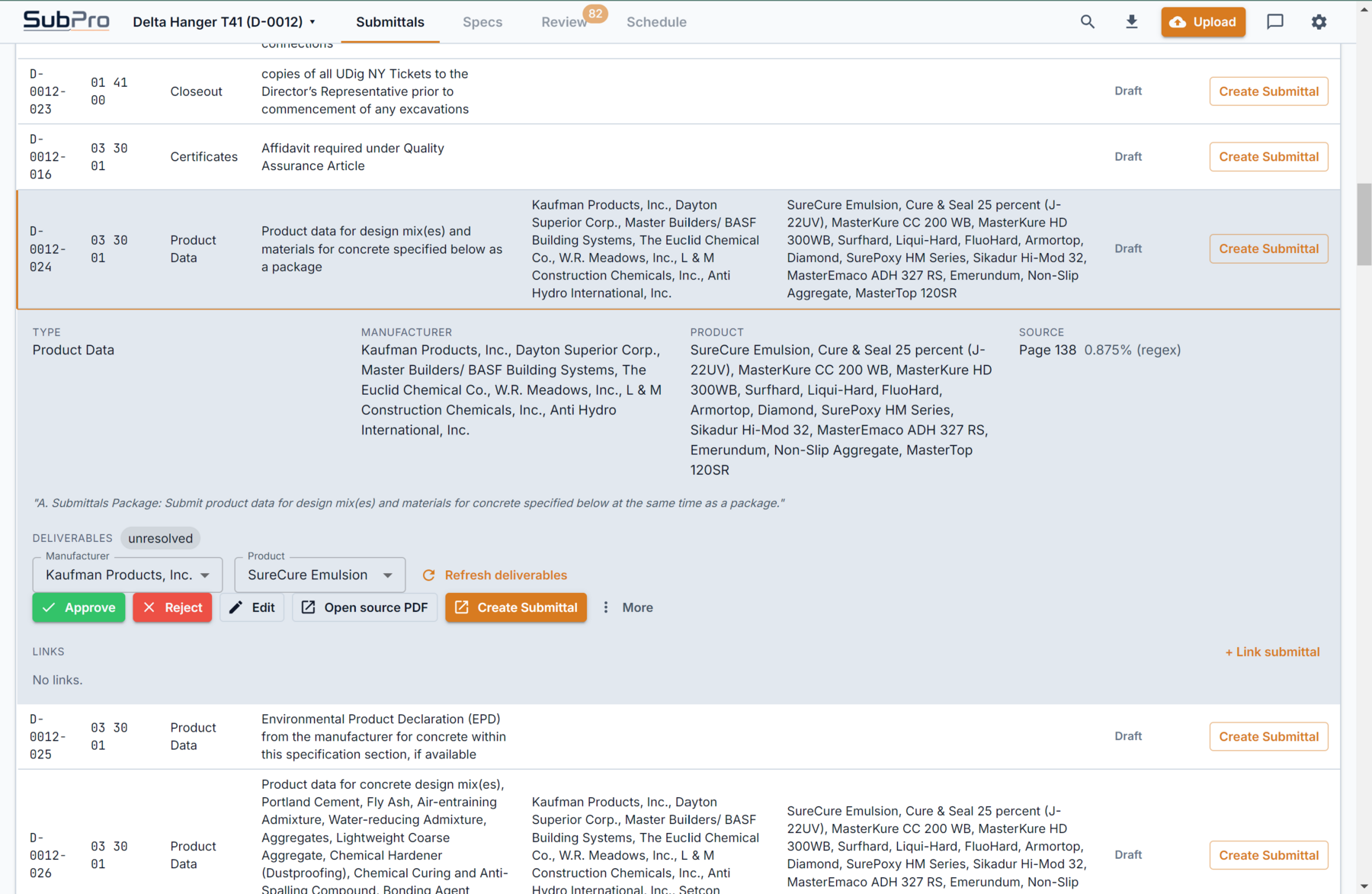
Review queueRows flagged for a decision
A submittal row opened for review in SubPro, showing its source citation and the details a reviewer checks

See the work before you talk to us

Real screens from sample projects, run end to end. Judge the output first.
See everything that ships
The source page for a submittal, with the requirement highlighted in the spec book
The requirement, on its pageOpen any row and the spec page opens with it, the requirement highlighted.
Manufacturer product documents matched to a submittal row in SubPro
Product data, matchedManufacturer documents from the library, matched to the row and ready to stack behind the cover sheet.
A finished submittal package open in a PDF viewer, cover sheet first, product data behind it
The finished submittal packageCover sheet, transmittal, and product data in one PDF, named and numbered for the GC.

The busywork automated. The decisions stay yours.

The manual week

  • Transcribe the spec book by handA coordinator, a spreadsheet, and several evenings. One missed row surfaces months later, usually from the architect.
  • Track down every cut sheetManufacturer sites, shared drives, merged PDFs, corrected page order. Repeated for every item on the log.
  • Rebuild the record at closeoutO&Ms and warranties become a second project, assembled under deadline at the end of the job.

With SubPro

  • A cited draft to reviewThe log lands with a spec page on every row, so your team starts at review instead of at transcription.
  • Submittal packages arrive assembledMatched product data behind a cover sheet. Gaps are flagged, never papered over.
  • Closeout builds as the job runsStatuses, revisions, and transmittals accumulate row by row and are ready at turnover.

What SubPro does not do

The limits, stated plainly, so the fit call can be short.

It does not replace your PM's review

SubPro drafts and organizes. Your team confirms each requirement, decides substitutions, and owns the final log. Flagged rows are there to be read by a person, and they are.

It does not promise a perfect extraction

Spec books contain contradictions, and some requirements are buried in a note. That is why every row carries its page citation: a reviewer can confirm any row against the source in seconds instead of taking it on faith.

It does not keep your documents

Your spec book arrives, the deliverables leave, and the working copies are wiped. Nothing you send trains a model. The full policy is on the data handling page.

It does not change what the GC receives

The output is the same product data, cover sheet, and transmittal you send today, as PDF and Excel files you can drop into any project platform. Nothing about your GC's process has to change.

It does not publish a price list

Price depends on how many projects you run and how many submittals each one carries, so SubPro quotes per shop after seeing a project manual. The pricing page explains what drives the quote and what every build includes.

Who it is built for

A fit

  • Trade contractors with spec-heavy scopes: doors and hardware, finishes, HVAC, electrical, and the sitework divisions.
  • Teams whose PM should be reviewing submittals, not transcribing the project manual.
  • Shops running several projects a year that want the register and the submittal packages started the week of award.

Not a fit

  • Scopes with a handful of submittals that a coordinator can list in an afternoon.
  • Teams looking for a tracking dashboard rather than the drafted work itself.
  • Anyone who needs the spec book kept on file after delivery. SubPro deletes it.

Send us one spec book.

One fit call and one of your real spec books. You will see the drafted log and a finished submittal package before you decide anything.